
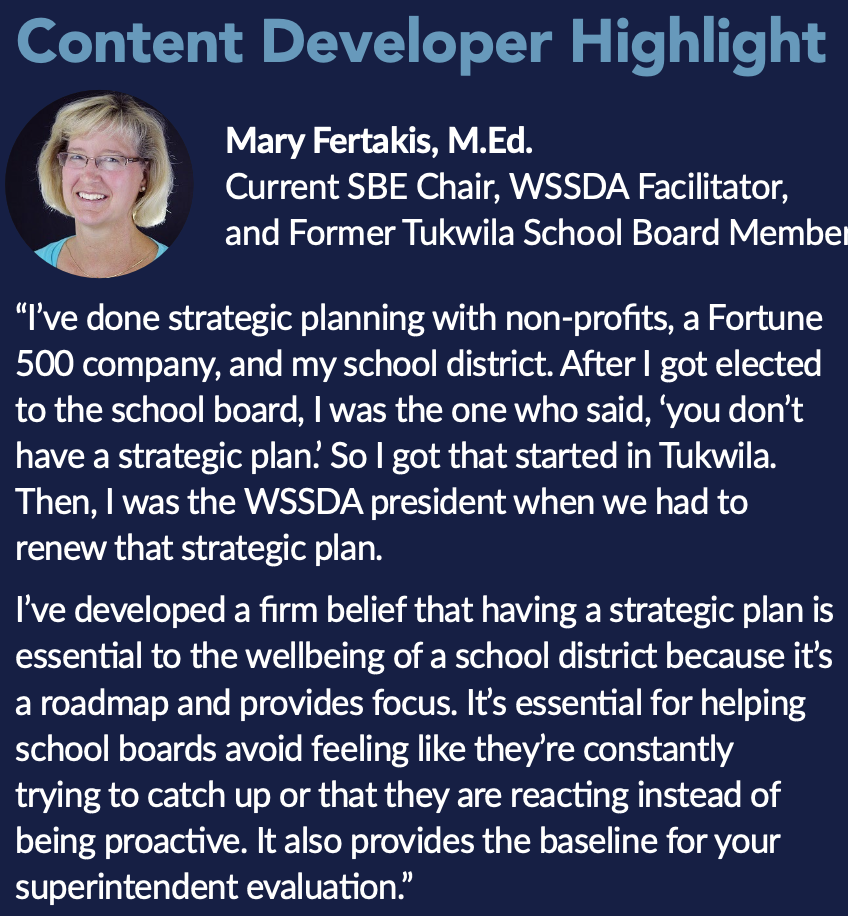
This article reflects the combined experience of WSSDA staff and Mary Fertakis, former school director, WSSDA president, and current State Board of Education member. The WSSDA’s strategic planning model was developed through close collaboration with her.
Strategic Planning, Uniquely for School Boards
Strategic planning is often described as essential to effective governance—but for school boards, it’s more than a best practice. It shapes decision-making, community trust, and long-term student success. Recognizing how unique this work is for public entities like school districts, WSSDA is excited to offer a strategic planning model designed specifically for school boards.
Unlike strategic planning in other sectors, like for-profit business, school district planning must balance multiple—and sometimes competing—inputs. School boards are charged with analyzing data that tells the story of how students and systems are performing, listening deeply to the lived experiences of families, staff, and students, and engaging the full board in each phase of the work. No single group can do this alone, and no single data source tells the whole story.
Turning Data and Community Voices into Clarity
WSSDA’s approach is built around the reality that the entire community needs to participate. The model weaves together three critical elements: authentic community engagement, rigorous data analysis, and consensus-building. The result is not just a document, but a shared vision that reflects district priorities and the values of the community the district serves.
By grounding conversations in district data and pairing that information with insights gathered through community listening sessions, boards begin to see where students are thriving—and where they are not. This approach can highlight where there are gaps—where students are not thriving.
That clarity helps boards focus their energy and resources where they can make the greatest difference.
Building Trust That Lasts Beyond the Plan
Just as importantly, inviting community members into these conversations builds lasting relationships. When people feel heard—and see their perspectives reflected in the final plan—they become champions for the district beyond the boardroom.
That trust doesn’t end when the plan is adopted. It can strengthen community engagement, improve transparency, and create shared ownership of the district’s direction—long after the planning process itself is complete.
Why an Outside Facilitator Matters
A key part of this work is the role of an outside facilitator. Acting as a neutral, trusted partner, WSSDA facilitators listen for themes, help organize feedback, and support groups in navigating conversations that can be difficult without an outside perspective.
Facilitators compile notes, analyze findings, and help align diverse viewpoints into a coherent whole—always focusing the effort toward a strategic plan the board, district, and community can be proud of. The facilitator’s presence can create space for honest dialogue and helps ensure every voice is heard.
 A Plan That Makes Board Work Easier
The benefits of strategic planning don’t stop once the plan is complete. A strong strategic plan makes the work of governance clearer and more manageable.
It provides a framework for asking the right questions, a calendar for monitoring progress, and a foundation for oversight. The plan also plays a critical role in superintendent evaluation, ensuring that progress on strategic goals, action plans, and objectives is central to that process.
Anchoring the Work That Matters Most
In the end, strategic planning isn’t an extra task—it’s the work that anchors all the rest. With the right structure, support, and intentional engagement, school boards can move from vision to action, creating a shared roadmap that reflects community priorities and keeps student success at the center.
Learn more about WSSDA’s strategic planning service.
This article originally appeared in the Winter 2026 issue of WSSDA Direct. Visit the WSSDA Newsmagazine to see all the latest issues of WSSDA’s newsmagazine.