
WSSDA is excited to offer a new superintendent evaluation model. It wouldn’t have been possible without an extensive, multi-year collaboration with WSSDA consultant and former Northshore board member Amy Cast.
Superintendent evaluation is one of the most important responsibilities of a school board. When done poorly, it can strain relationships, create confusion, and divert attention from student outcomes. When done well, it becomes a powerful governance tool—one that supports alignment, growth, and shared leadership.
In listening to districts across the state, WSSDA heard a consistent message: boards wanted more support not only in what to evaluate, but in how to conduct evaluations that are clear, fair, and grounded in the real work of the district. That feedback led to a review of best practices and the development of a strategic goal-centered superintendent evaluation model.
Starting With Purpose, Not Paperwork
At its core, the goal-centered model reframes superintendent evaluation as an extension of effective governance rather than a standalone event. Instead of starting with a checklist or rating form, the process begins with a foundational question: What is the board trying to accomplish on behalf of students and the community?
By anchoring evaluation in the district’s strategic goals, boards can assess superintendent performance in ways that are meaningful, transparent, and future-focused. When a district has a current strategic plan—and engages in regular board self-assessment and goal setting—the evaluation process becomes a natural continuation of ongoing governance work, not an isolated annual task. This approach clarifies expectations from the outset and aligns the superintendent’s work with the board’s vision, values, and priorities.
A Thoughtful, Structured Process
WSSDA’s model illustrates three phases: alignment, process, and outcomes.
First, boards are encouraged to align with the superintendent and amongst themselves on their collective hopes and expectations for the evaluation process.
Next, the model outlines a clear structure, including suggested t imelines, opportunities for reflection and feedback. Rather than rushing to an end-of-year conclusion, boards are encouraged to treat evaluation as an ongoing cycle that supports mid-course adjustments and deeper conversation.
Finally, the process arrives at outcomes. Instead of ending with a summary or rating alone, boards identify actionable next steps that inform future goal setting, professional development, and board-superintendent collaboration.
Balancing District Success and Leadership Growth
While district goals remain central, the model also incorporates leadership and operational goals that support the superintendent’s professional growth. This dual focus recognizes that strong district outcomes depend not only on results, but on the superintendent’s capacity to lead people, manage complexity, and adapt to changing conditions.
By including leadership development in the evaluation process, boards reinforce their role as partners in growth—supporting the superintendent while maintaining accountability for district performance.
Creating Space for Honest, Productive Conversations
Boards often cite similar challenges with superintendent evaluation: unclear expectations, uncomfortable conversations, or feedback that feels too vague or punitive. The goal-centered model addresses these concerns by providing structure and shared language around performance.
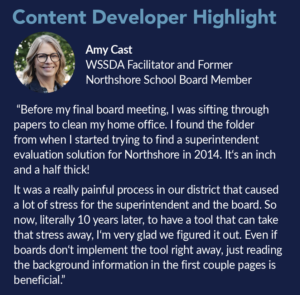
Grounded in district goals and reviewed regularly, the process supports candid, constructive conversations about progress, strengths, and areas for growth—for both the superintendent and the system they lead. Evaluation becomes less about surprises and more about continuous improvement.
Built from the Field, for the Field
WSSDA’s strategic goal-centered superintendent evaluation model reflects what boards across the state asked for: practical guidance rooted in real governance work. Flexible enough to adapt to local context and structured enough to provide consistency year over year, the model reinforces the board’s core responsibility—keeping the focus on students and community by aligning superintendent evaluation with the district’s most important goals.
Learn more about WSSDA’s superintendent evaluation models.
This article originally appeared in the Winter 2025 issue of WSSDA Direct. Visit the WSSDA Newsmagazine to see all the latest issues of WSSDA’s newsmagazine.