
Written by:
Kathy LaPointe, Director of Communications, Partners for Rural Washington.
While Washington’s public schools navigate a variety of complex hurdles – from unfunded mandates and rising operation costs to an evolving post-COVID learning landscape – some rural districts are meeting the challenges with innovation.
A new public-private partnership called The Giving Grid is emerging as a literal ray of financial sunshine.

The Giving Grid installs solar power systems on or near school buildings with no upfront costs to the school district, thanks to funding through state utility tax credits managed by the Washington State University Extension Energy Program. The district reaps the energy savings. For the first 10 years after installation, the district must reinvest those savings into programs for low-income students.
Since the average lifespan of a solar power system is 30-plus years, use of any savings after the first 10 years becomes discretionary. Teacher salaries? New programs? Aging infrastructure? It’s up to each school district and its board.
Currently, The Giving Grid includes 36 projects in 13 school districts and two municipalities.
“We are seeing massive energy savings already,” said Courtney Strozyk, superintendent at Harrington School District, the first district to join The Giving Grid. “Our first year in the program will be up in September, and we’re looking at about $15,000 in energy savings.”
The Giving Grid is the brainchild of David Funk, president of the private corporation Zero Emissions Northwest. As the saying goes, necessity is frequently the mother of invention.
“It was truly lemons to lemonade for me and my team,” Funk said. “When the new administration froze all federal grants and we were forced to furlough staff, an idea— about community solar and how it could give back—ignited.”
Funk has worked in energy and finance for close to 20 years and knows the value of free sunshine.
“I’ve seen what solar can do and how it can save communities a lot of money,” he said. “Our existing work with the USDA on energy efficiency in rural communities provided us with a strong and familiar presence in those areas. That foundation allowed us to connect with the WSU Extension Energy team and shape a community solar program alongside PRWA.” The Giving Grid program hinges on strong partnerships with Partners for Rural Washington and WSU.

Jody Opheim, PRWA’s executive director, echoed Funk’s sentiments and said The Giving Grid aligns perfectly with its mission to drive prosperity in Washington’s small rural communities.
“Rural schools are an anchor for the communities they serve,” she said. “They educate, feed and care for each town’s youth. It’s where the community gathers for school—and even non-school—events. It’s often the go-to facility during a disaster or other emergency.
“These schools have to make tough decisions weekly about how to spend what little discretionary funding is available,” she continued. “The Giving Grid puts, on average, $10,000 to $15,000 per building every year into each school’s budget. I know of no other source of funding available to rural schools that can do that.”
For some of the superintendents of districts that have joined the program, it almost seems too good to be true.
“Our board was a tough sell and said, wait a minute, what’s the catch,” said Kevin Knight, superintendent in Colville. “But once they understood that it wouldn’t cost the district anything to install, and we would get to use the money we saved in energy costs to help kids, they were all in.”
Solar installations have been completed on four school buildings in Colville, and the district is hoping to add a fifth next year. Knight said they are anticipating about $40,000 in savings after the first year.
Juston Pollestad, executive director of operations at Pullman School District, agreed with Knight.
“My mom always said if something sounds too good to be true, it probably is,” he said. “But, The Giving Grid is one of those things that really is as good as it sounds. Any time we can put ourselves in a win-win for the kids, the district and the schools, we’re going to do that.”
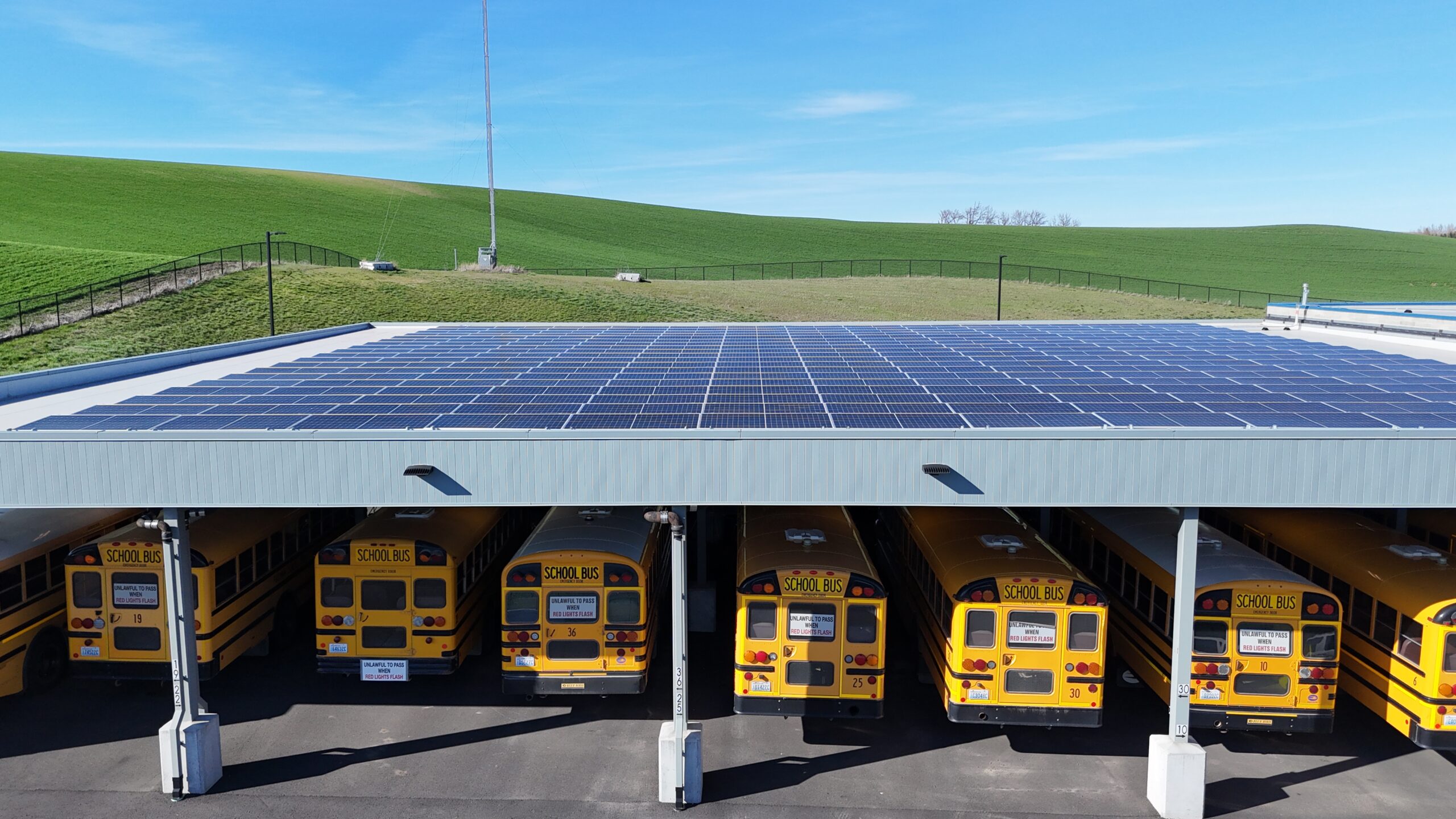
Pullman has solar panels installed on four of six buildings, and eventually anticipate energy savings of between $80,000 and $100,000 a year. Pollestad noted that the solar project installed on the top of the district’s bus garage is helping to charge their electric school buses. Pullman recently received a grant for an additional charger in the bus garage so they can expand the EV fleet, realizing even more savings with the rising cost of diesel fuel.
Overall, the consensus among districts is elation and surprise – primarily at how easy the process is.
“From the first time that we met David (Funk) to the time we flipped the switch was nothing,” said Mike Jones, who currently serves as superintendent for both Palouse and Tekoa School Districts.

Ellensburg Solar, the solar installers and contractor, have proven to be integral to the success of The Giving Grid.
“Ellensburg Solar was super responsive and super professional,” said Pollestad from Pullman. “When they said it would take 10 days, they either did that or they were early.”
The true impact of The Giving Grid, though, lies in how each district will spend its energy savings to support eligible low-income students.
“Food service is our top priority,” said Jones from Palouse and Tekoa. “We want to continue to provide meals, but also want to add snacks for our afterschool program.” His districts are anticipating up to $45,000 in energy savings each year.
“Our savings will go to where the most need is,” Pollestad from Pullman said. “Athletic equipment so every student who wants to can participate. Winter coats. Money to pay for AP and college-level testing.”
“We’re planning to supplement activities, experiences and technology for our low-income students,” said Strozyk from Harrington. “We want all of our students to have the same experiences that more affluent school districts have.”
“Our guideline is that every dollar has to go toward kids,” Knight from Colville said. “It’s being able to send the kids who qualified for nationals in Rocket Club to the competition. Or cover basic needs, like clothes for a family whose house burns down. Our school population is 60 percent low income, so we’re just excited to be able to put money toward what’s best for kids.”