
AASA—School Administrator Magazine
NSBA—American School Board Journal
Every few days, as Americans turn on our TVs or scroll through social media, another school shooting fills our screens. Heartbroken by the loss of innocent lives and frustrated by a lack of pushback on the gun violence epidemic, we brace ourselves for the next attack.
While campus shootings dominate the news cycle, many people cannot fully grasp how gun violence outside school doors impacts – and devastates – our school communities. In 2024, more than 1,400 children¹ were killed by gun violence, and another 3,900 were injured.² Thousands more students have experienced the loss of a friend or loved one.
That trauma ripples through a school district, touching every student, educator, and administrator, leaving enduring scars that can disrupt a child’s educational experience. According to Stanford University,³ children exposed to a shooting experience higher rates of depression, chronic absenteeism, and declining test scores. They are also less likely to graduate from high school and attend college.
For school districts across Washington state, prioritizing student safety is paramount to student success. Said John Belcher, superintendent of Cle Elum-Roslyn School District, “School leaders are not going to bury our heads and assume someone else is going to keep our kids safe. As a superintendent, that’s my ultimate job. Educating students comes second after ensuring kids are fed, they’re mentally well, and they’re physically fit. We have to really center our work on student safety and well-being first, or our kids are never going to meet their academic goals.”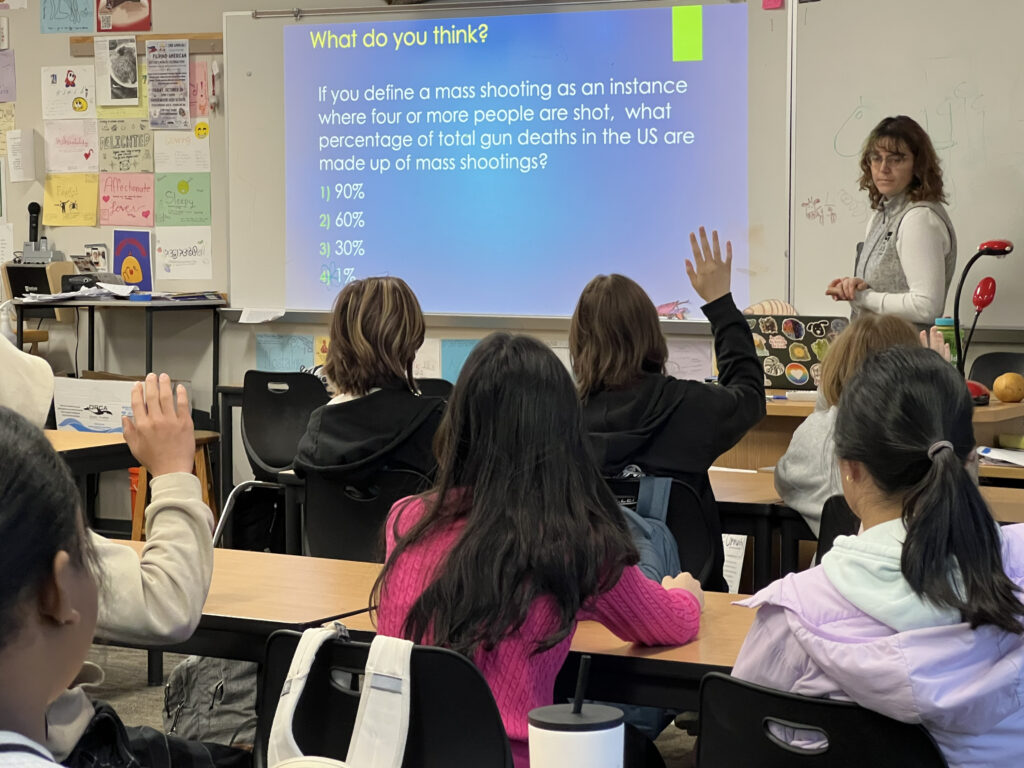
Combatting gun violence requires a community-driven, collaborative approach to education and advocacy – one that demotes politics from the center of discussion and reframes the epidemic as a public health crisis. Helping guide schools through the process is Ceasefire Northwest,⁴ formerly known as Washington CeaseFire, a nonprofit that brings Firearm Injury Prevention Education⁵ to schools throughout Washington and Oregon.
Led by physician and epidemiologist Dr. Gregory Engel, Ceasefire Northwest’s firearm-related harm reduction program is delivered in the classroom by guest speakers. The supplemental material aligns with state standards and integrates effortlessly into high school health curriculum.
This past year, the organization has provided gun safety education to more than 5,000 students, and according to those who’ve participated in the program, it has already influenced how today’s kids will play a critical role in advancing gun safety policies in the years to come.
Empowering Students To Become Advocates for Themselves
Like her fellow students in the Highline Public Schools district, high school senior An Mai carries the weight of living in a post-Columbine world. Even without an immediate threat, a student’s fight or flight response can be triggered by a news story or a loud noise during the school day, leaving kids in a constant state of hypervigilance and anxiety.⁶
“Gun violence is all around us, whether it’s through news outlets, the stories we hear from our friends, or even the lockdown drills that are written into a school’s safety protocol,” she said. “It’s something that we, as students, have to live with constantly. And for many of us, it’s not a political issue, but a lived experience. Adults need to start understanding that by ignoring gun violence, dismissing it as being too heavy of a topic, or thinking we’re too young to discuss it leaves my generation feeling more isolated about these problems we have to deal with every day.”
Mai is not alone. John Woodrow Cox, author of “Children Under Fire,” found that four to eight million children⁷ experience a school lockdown each year. Even if the threat is real or a false report, the trauma they endure can last long after the all-clear. At the same time, access to in-school mental health support for students has been impacted⁸ by budget cuts and federal restructuring. Therefore, it’s not surprising that 75 percent of adolescents⁹ today say they are worried about school gun violence.
Mai was introduced to Ceasefire Northwest in 2024. According to Mai, Dr. Engel’s class was the first she encountered that viewed gun violence through a lens of epidemiology, allowing for a more nuanced understanding of the problem – one that is often silenced by back-and-forth partisan debates. It’s this alignment with health standards curriculum that has allowed Ceasefire Northwest to start the conversations that have been too controversial for classroom discourse.
Explained Dr. Engel, “Schools have done really fine work in the areas of sexual health and the awareness of drugs and drug abuse. Firearm safety is another health issue that, when positioned correctly, can bring important knowledge to our students and our communities. We are not here to threaten people, their identity, or their culture – we are here to teach strategies to reduce students’ risk of gun injury.”
As an organization, Ceasefire Northwest does not promote or oppose gun ownership, but instead, empowers students with critical thinking skills to confidentially navigate the ongoing gun safety debate in our country and challenge misinformation on gun violence – all in a neutral, non-judgmental learning environment. Its approach to instruction and class discussion is built on four key pillars that help students:
- Recognize firearm injuries as a public health problem
- Decipher research data to identify people who are at high risk of becoming victims of gun violence
- Identify warning signs of concerning behaviors, including threats of harm to themselves and others, that should be reported to trusted adults
- Gain a better understanding of current gun laws and policies
For Mai, Ceasefire Northwest helped her identify protections that already exist, such as red flag laws and background checks, and allowed her to think more critically about the stories that society accepts from media, lawmakers, and gun companies.
“I don’t think guns are necessarily the root problem or even the people who misuse them,” she said. “As I see it, it’s more the misinformation that guns inherently make us safer. I think that this myth is why millions of Americans do buy firearms for self-defense, even though studies show that guns in homes actually double the risk of homicide¹⁰ and triple the risk of suicide¹¹.”
In the Edmonds School District in Lynnwood, Ceasefire Northwest has become part of a broader health unit for freshman students. Assistant superintendent Greg Schwab and health teachers, Melissa Boswell and Jenny McCloughlan, were at the frontline of developing the program for Edmonds, working side-by-side with Firearm Injury Prevention Educators to design curriculum that would connect best with their students.
With hands-on instruction and the evidence-based data to back it up, this empowering approach to gun safety resonated with students who had been rocked by the gun deaths of multiple classmates over the past three years.
“Because gun violence is discussed from a public health perspective, it is really aimed at giving kids strategies for what to do when they find themselves in a situation where there are firearms,” said Schwab. “The curriculum is equipping them with the information they need to make the right decisions.”
The need for in-school education programs like Ceasefire Northwest is more important than ever, with firearms deaths continuing to climb among middle and high schoolers¹². According to researchers from Washington State University, engaging students in intervention¹³ efforts that are tailored to their developmental stage is essential to informing prevention strategies.
With Ceasefire Northwest, students aren’t passive listeners in gun safety lectures – they become a vital voice in the nationwide discussion of violence prevention and help create a culture of greater respect and responsibility. As Mai explained, many students who leave a CeaseFire session feel a stronger sense of duty to educate others on gun violence both in their school and home communities.
One State, 1000 Different Stories
When compared to other states, Washington is a leader in passing gun safety legislation. With universal background checks and 10-day waiting periods to bans on assault weapons and child access prevention laws, the state has secured an A- grade on the Giffords Gun Law Scorecard¹⁴.
Even with the strides Washington has made to protect its children, firearm mortality rates continue to increase. Every 10 hours¹⁵, someone in Washington dies by gun violence, and in 2023 alone, 45 children ages one to 17¹⁶ lost their lives to this preventable crisis.
Just how the gun violence epidemic impacts a community – and how community members view the topic of firearms – varies in different areas of the state. In urban communities, homicides have become the leading cause of death¹⁷ for high schoolers, and Black children and teens are twice as likely to be killed¹⁸ by a gun as their white peers. While in rural areas, suicide is the primary cause¹⁹ of firearm death for youth. In fact, suicide accounts for 53 percent²⁰ of adolescent gun deaths statewide.
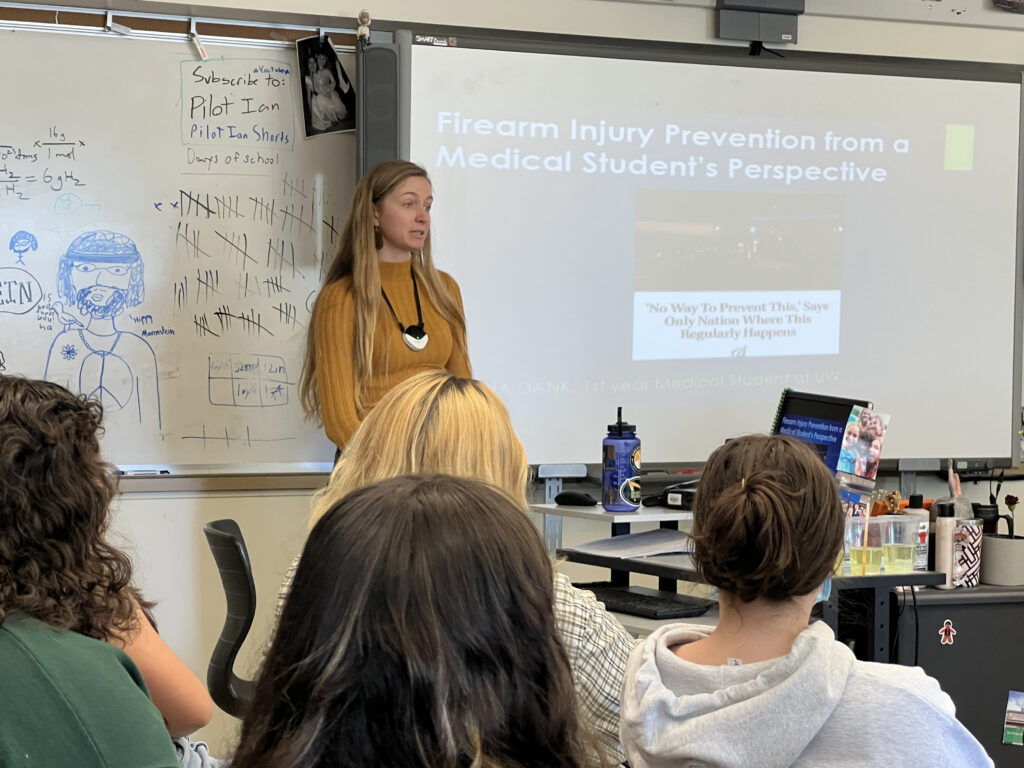
Walking the fine line between addressing gun violence and respecting Second Amendment rights can be difficult, but Ceasefire Northwest is doing it successfully.
“There’s really been no difference in the program’s reception between rural schools and urban schools,” said Dr. Engel. “We’ve taught more than 12,000 kids and have received zero complaints from students, zero complaints from parents, and zero complaints from teachers and administrators. It surprises many people that we haven’t had pushback on this topic, but what this speaks to is there’s a general feeling that gun violence is an issue of importance, one based on children’s health.”
Ensuring Ceasefire Northwest remains apolitical has meant understanding how communities view gun ownership and how best to communicate more effectively with a public that holds differing views on gun rights. For instance, David Ruby, a social studies teacher with Highline High School, accompanied Dr. Engel on a visit to a gun show in the Key Peninsula to better understand both sides of the gun debate.
“He wanted to see what the experience was like,” said Ruby. “To hold the guns, and meet with the people who were there, and discover what kind of questions would be asked about the program. I have done some of this shoe leather work with Dr. Engel. He tries really hard through his team to make gun safety a very apolitical issue and look at it more through the lenses of education and science.”
According to Belcher, it’s Dr. Engel’s ability to ground presentations in facts as well as the district’s commitment to communication and transparency that helped Cle Elum-Roslyn avoid any pushback in a rural community with high gun ownership.
Embedding the Ceasefire Northwest curriculum into its district-wide wellness campaign was key to Cle Elum-Roslyn’s success. Registered nurses and community prevention specialists led evening events for students and parents centered on a variety of safety topics, including outdoor survival skills, mental health, and cyber safety. Since gun safety was just one part of the district’s broader wellness education efforts, parents didn’t express any concerns about the program.
Belcher noted that Cle Elum-Roslyn has seen positive changes in its student population thanks to programs like Ceasefire Northwest. Students have normalized mental health conversations and are more open to seeking help when needed. They are also more comfortable reaching out to trusted adults through the district’s tip line to alert them about possible concerns.
“One of the best things about the program is that our students have requested we continue education around these themes. School leaders are even talking about revising our graduation policies to have some kind of required life courses in them.”
On the west side of the state, Dr. Engel led the CeaseFire course in a classroom which was in sight of a recent student shooting on campus.
“I don’t think the things I say to students in Western Washington need to be all that different from what I say in rural environments,” said Dr. Engel. “But the reality is, urban firearm violence is different from rural firearm violence. So, I spend more time trying to address specific topics in these schools and tailor information. The teachers in that classroom are really still shaken by that shooting. They are not the same folks they were before.”
Dr. Josh Garcia, superintendent of Tacoma Public Schools (TPS), has been struggling with the aftermath of ongoing gun violence in his community as well. Helping students cope after tragedy has unfortunately become central to his role – in the 14 years he has served the district, he has lost dozens of students to gun violence.
To help keep children safe outside of school hours, TPS partnered with community organizations to extend afterschool opportunities as well as host a Summer Late Nights²¹ program where students could participate in sports, arts, and activities throughout the summer. The district also partnered with Ceasefire Northwest to help educate teachers on the best way to address gun safety with their students and is working on a series of guest columns to put out to the general community.
However, according to Dr. Garcia, curbing gun violence cannot be accomplished by schools alone – it requires a community education effort that has yet to materialize.
“There’s so much attention on schools being unsafe,” he shared. “What you don’t hear about is how violence in the community pours into the schools. The conversation has to broaden to address the root causes in the community. And this is true of many issues that impact academic performance. We have to keep talking about the whole child and broaden supports 24-7, 365 days a year.”
It’s an issue that frustrates Dr. Engel as well, and one that requires both ongoing discussion and immediate action.
“The safety of our kids is only urgent in the community conversation when there’s been a mass shooting, right? That’s one of the things I teach students about. We think about school shootings and mass shootings as the face of the problem, but mass shootings make up two percent of all firearm deaths in our country. On a typical day, 120 people in our country die from firearms, and 70 of them are suicides. Those are the stories that are not talked about.”
Working Toward a Safer Future for All Washington Students
The team at Ceasefire Northwest is a small one, so reaching as many students as possible requires building and training a cohort of educators who can adapt the organization’s program to the students they serve.
For instance, Ceasefire is working with make the Edmonds School District to make its firearm safety program an open-access resource for all health teachers – one that dovetails seamlessly with any district’s existing curriculum.
“Presentations are most impactful when they are given by the health teachers who students know and trust,” explained Dr. Engel. “That’s how education should work. It shouldn’t always be an old epidemiologist showing up in the classroom. There’s value in that, but that’s not the future.”
Dr. Engel is also working with medical students from the University of Washington School of Medicine to expand the program. Besides serving as classroom educators, the students are gathering data on results of the program, which has been submitted to the Journal of School Health.
Because students are most impacted by gun violence that happens outside of school hours, Ceasefire Northwest is addressing the public health crisis on a community-wide level. For instance, Ceasefire has partnered with city mayors and private businesses on its Gun Free Zone Program. Business owners can designate their companies as “gun free” zones with the hope of creating safer, more hospitable environments for employees and customers.
In addition, since 50 percent of unintentional firearm injury deaths²² among children occur in the home, Ceasefire’s Asking Saves Kids (ASK) program works to normalize conversations about firearms in social settings. Ceasefire encourages parents to ask about the presence and storage of firearms in the home. Yet, in an informal study of its students, only one to three percent of kids say this question is asked by their families.
With all the work Ceasefire Northwest has done in Washington, its greatest impact can be seen in the students who have sat in Dr. Engel’s classrooms and are ready to challenge a status quo that continues to put their safety at risk.
“I think our generation is willing to have those uncomfortable conversations that past generations were less encouraged to have at our age,” said Mai. “Even though gun violence is such a heavy subject, I have seen myself, my peers, and the people around me approach it with such empathy and urgency. I hope that within my lifetime, I do see a measurable change in gun violence within new laws, within new policies, and within education. I have confidence that we won’t just inherit these same problems from the past – we’re going to continue to work together to change them.”
To learn more about bringing Ceasefire Northwest to your district, volunteer with the organization, or find out more about advocating for safer schools and communities, contact Dr. Engel at ga_engel@yahoo.com.
Footnotes
- Past Summary Ledgers. Gun Violence Archive. https://www.gunviolencearchive.org/past-tolls
- Past Summary Ledgers. Gun Violence Archive. https://www.gunviolencearchive.org/past-tolls
- Rossin-Slater, M. (2022, June 1). Surviving a school shooting: Impacts on the mental health, education, and earnings of American youth. Stanford Institute for Economic Policy Research. https://siepr.stanford.edu/publications/health/surviving-school-shooting-impacts-mental-health-education-and-earnings-american
- https://www.ceasefirenorthwest.org
- (2024, February 6). Why We Teach Students about Firearm Injury Prevention [Video]. Ceasefire Northwest. https://drive.google.com/file/d/1yI-WJirta7jCNcC-57HMFek6hfBh8lud/view?pli=1
- Riehm KE, Mojtabai R, Adams LB, et al. Adolescents’ Concerns About School Violence or Shootings and Association With Depressive, Anxiety, and Panic Symptoms. JAMA Netw Open. 2021;4(11):e2132131. doi:10.1001/jamanetworkopen.2021.32131
- (2022, June 4). As School Shootings Claim More Victims, Young Activists Want to Be Heard. National Public Radio. https://www.npr.org/transcripts/1100356298
- Panchal, N. (2026, March 12). Child and Adolescent Firearm Deaths: National Trends and Variation by Demographics and States. KFF. https://www.kff.org/mental-health/child-and-adolescent-firearm-deaths-national-trends-and-variation-by-demographics-and-states/
- Kirkland, D., M.A., Fu, T. C., M.Sc. Ph.D., Herbenick, D., Ph.D. M.P.H, & Hensel, D. J., Ph.D. (2026). Frequency and Predictors of Adolescent Worry for School Gun Violence in the United States: Findings From a Nationally Representative Study. Journal of Adolescent Health, 78(1), 166-172. https://www.jahonline.org/article/S1054-139X(25)00436-7/abstract
- Duff-Brown, B. (2022, April 4). Californians living with handgun owners more than twice as likely to die by homicide, study finds. Stanford Medicine News Center. https://med.stanford.edu/news/all-news/2022/04/handguns-homicide-risk.html
- Gun Suicide Across the States. Brady. https://www.bradyunited.org/resources/issues/gun-suicide-across-the-states
- Panchal, N. (2026, March 12). Child and Adolescent Firearm Deaths: National Trends and Variation by Demographics and States. KFF. https://www.kff.org/mental-health/child-and-adolescent-firearm-deaths-national-trends-and-variation-by-demographics-and-states/
- Weybright, E.H., Terral, H.F., Conrick, K.M. et al. Trends in firearm death among middle and high-school aged rural and urban adolescents from 2001 to 2022. Inj. Epidemiol. 12, 53 (2025). https://doi.org/10.1186/s40621-025-00613-w
- Annual Gun Law Scorecard. Giffords. https://giffords.org/lawcenter/resources/scorecard/
- (2023) Gun Violence in Washington State by the Numbers. Alliance for Gun Responsibility. https://gunresponsibility.org/wp-content/uploads/2023/09/2023-GV-Fact-Sheet.pdf
- Johns Hopkins Bloomberg School of Public Health (n.d.). Gun Violence in Washington State by the Numbers. Center for Gun Violence Solutions. https://publichealth.jhu.edu/center-for-gun-violence-solutions/data/state-gun-violence-data/washington
- Fitzgerald, E. (2025, October 9). Gun deaths among high schoolers on the rise, WSU study finds. Washington State Standard. https://washingtonstatestandard.com/2025/10/09/gun-deaths-among-high-schoolers-on-the-rise-wsu-study-finds/
- (2023) Gun Violence in Washington State by the Numbers. Alliance for Gun Responsibility. https://gunresponsibility.org/wp-content/uploads/2023/09/2023-GV-Fact-Sheet.pdf
- Fitzgerald, E. (2025, October 9). Gun deaths among high schoolers on the rise, WSU study finds. Washington State Standard. https://washingtonstatestandard.com/2025/10/09/gun-deaths-among-high-schoolers-on-the-rise-wsu-study-finds/
- (2021) Gun Violence in Washington State by the Numbers. Alliance for Gun Responsibility. https://gunresponsibility.org/wp-content/uploads/2021/12/GV-Fact-Sheet-1.pdf
- Duke, S. (2024, January 10). Pressed for Time and Facing Tragedy, a City Transforms into a Youth-Centered Community. WSSDA Direct, (Winter), 16-19.
- (2023, December 15). Unintentional Firearm Injury Deaths Among Children and Adolescents Aged 0–17 Years — National Violent Death Reporting System, United States, 2003–2021. Centers for Disease Control. https://www.cdc.gov/mmwr/volumes/72/wr/mm7250a1.htm